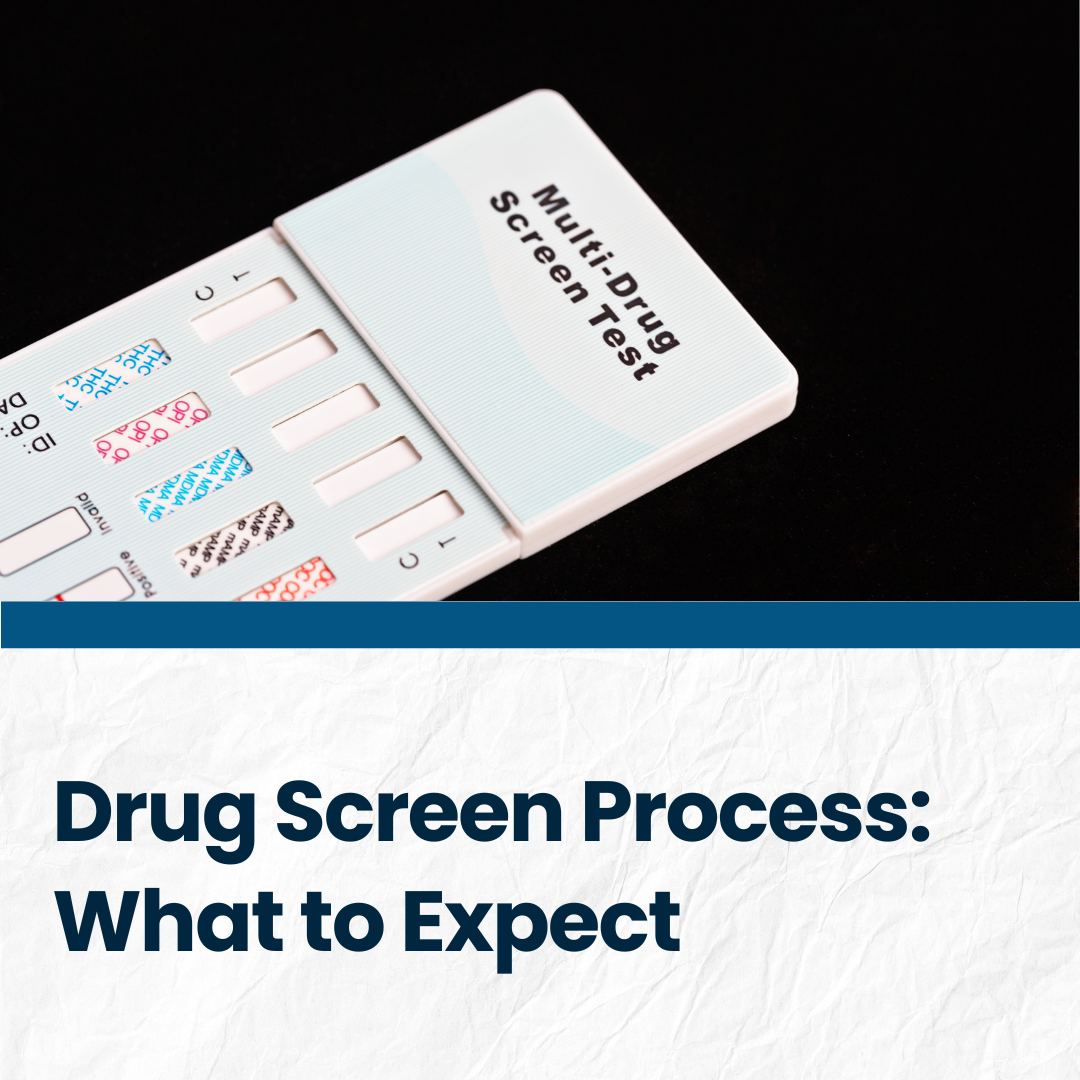
Workplace drug screening follows a standardized chain-of-custody process designed to produce legally defensible results. Understanding how each step works (from test authorization through final documentation) helps employers maintain compliance and helps employees know exactly what to expect.
This guide walks through the complete drug screening process in practice, including common complications, timing considerations, and what to do when issues arise.
Who This Guide Is For
This procedural guide is written for:
- Employers implementing or managing workplace drug testing programs
- HR and compliance teams are responsible for test coordination and recordkeeping
- Employees who have been directed to complete a drug screen and want to understand the process
- Safety managers preparing for DOT audits or compliance reviews
The process described applies to pre-employment, random, post-accident, reasonable suspicion, follow-up, and return-to-duty testing. Specific requirements vary depending on whether DOT regulations apply and the type of test ordered.
How Workplace Drug Screening Actually Works
Workplace drug testing follows standardized chain-of-custody protocols that ensure specimen integrity from collection through laboratory analysis. These procedures apply whether testing is conducted under DOT regulations or company policy.
Every drug screen follows the same eight-step process, regardless of who orders the test or where it’s conducted. What changes is who handles coordination, how quickly results are received, and what documentation requirements apply.
Step 1: Test Authorization and Notification
The drug screening process begins when an employer determines a test is required and initiates the authorization.
For employers managing their own testing: You must enter into contracts or agreements with collection sites, establish billing protocols, and engage your AP team to handle W-9 forms and vendor setup. You’ll need to order forms, collection cups, and shipping supplies from the laboratory and ensure delivery to the collection site. Only after completing these administrative steps can you send employees for testing. You then contact the collection site directly, provide the employee’s information, and receive the authorization paperwork to give to the employee.
For employers working through a third-party administrator: The administrator locates an available collection site, authorizes testing at that facility, and provides a pre-authorization form. The employer then gives this form to the employee and directs them to the testing location.
In PROCOM’s process, test administrators locate the nearest facility, handle authorization, and provide the employer with documentation to hand to the employee. For our full range of drug testing and compliance services, see here.
The employer sends the employee to the site with the pre-authorization form. PROCOM does not typically contact employees directly unless they’re scheduled at a PROCOM-operated collection site or an on-site collection is arranged.
Timing considerations:
- Pre-employment testing is typically given a short window, like 24-72 hours, to complete the testing
- Random testing provides no advance notice. Employees are notified and must proceed with testing immediately
- Post-accident testing must occur as quickly as possible, ideally within 2 hours of the accident
- Reasonable suspicion testing requires immediate collection, ideally within 2 hours of initial observation
Many collection facilities require appointments for collection services. The PROCOM network almost exclusively operates on a walk-in basis, meaning employees do not need appointments and can report during regular business hours.
Step 2: Employee Reports to Collection Site
The employee arrives at the designated collection facility with their pre-authorization form and valid photo identification.
What qualifies as a valid ID:
Any photo ID is acceptable for identification purposes. This can include:
- State-issued driver’s license or ID card
- Passport
- Military ID
- Employee ID card with photo
- Other photo identification
The collector verifies the employee’s identity by comparing the photo ID to the individual and confirming the name matches the authorization paperwork.
Common issues at this stage:
- Employee arrives without ID: The test cannot proceed. The employee must return with proper identification or have visual confirmation from the employer representative.
- Name mismatch between ID and paperwork: The collector contacts the authorizing party to verify identity before proceeding.
- Collection site is closed or collector unavailable: If PROCOM authorized the test, contact information is printed on the pre-authorization form. The administrator can immediately reschedule or redirect the employee to an alternate location.
Most collection facilities operate during standard business hours, typically 8 AM to 5 PM on weekdays, though some locations offer extended or weekend hours. In rural or underserved areas, collection availability may be limited, requiring advance coordination for time-sensitive tests.
Step 3: Chain of Custody Initiated
Before any specimen is collected, the collector initiates a chain-of-custody (CCF) form. This document serves as the legal record of the specimen from collection through laboratory analysis and result reporting.
Key information recorded on the CCF:
- Employee name and identifying information
- Test reason (pre-employment, random, post-accident, etc.)
- Employer name and contact information
- MRO adjudicating the test result
- Date and time of collection
- Collector signature and certification
- Specimen ID number that links the sample to the paperwork
The employee reviews the form for accuracy upon collection of the specimen and signs to certify the specimen. This signature does not indicate consent to testing. It confirms that the specimen was collected and that the information matches their identification.
Why chain of custody matters:
If documentation contains errors, the specimen may be rejected by the laboratory, or results may be delayed. Common documentation errors include illegible handwriting, incomplete employer information, missing signatures, or problems with fax transmission.
PROCOM uses electronic CCF forms whenever possible to eliminate handwriting, errors of noncompletion, and fax issues, which are the most frequent causes of laboratory delays.
Employer recordkeeping responsibility:
The CCF must be retained in accordance with regulatory requirements. For DOT testing, this is a federal document with specific retention schedules. Employers are responsible for maintaining their own files, even when working with a third-party administrator. In the event of an audit, regulators expect employers to produce these records immediately. Relying solely on a third party to provide documentation during an audit creates unnecessary risk and delays.
PROCOM retains all documentation needed for employer records and makes it available through a client portal, but recommends that employers maintain their own files rather than relying entirely on the administrator’s records during compliance reviews.
Step 4: Specimen Collection
The type of specimen collected depends on what the employer ordered and what substances are being tested.
Common collection types:
Urine drug testing is the most widely used method for workplace drug screening. The employee provides a urine specimen in a collection cup under controlled conditions that maintain privacy while preventing tampering. The collector verifies specimen temperature and appearance to ensure validity.
Oral fluid (saliva) testing involves collecting a saliva sample with a swab. This method is increasingly common for post-accident and reasonable-suspicion testing because it can be performed on-site and detects very recent use.
Breath alcohol testing uses a calibrated evidential breath testing (EBT) device to measure blood alcohol concentration. The employee provides a single breath sample. If alcohol is detected, there is a 15-minute wait period, followed by a second test. The second test is the final result. If no alcohol is detected on the first breath, only the first breath is recorded.
What happens if an employee cannot provide a specimen:
The most common collection issue is “shy bladder,” in which an employee cannot immediately provide sufficient urine volume (typically 45 mL). This is not considered a refusal to test.
The employee remains at the collection site, drinks water (up to 40 ounces over a 3-hour period), and attempts to provide a specimen again. Most shy bladder situations resolve within 90 minutes. If the employee still cannot provide a specimen after 3 hours, the collector documents the situation and records it as a refusal to test. The employee may contest the result by undergoing a medical evaluation to determine if there is a medical reason for the inability to provide a sample.
Refusal to test:
An employee who refuses to proceed with testing, refuses to sign paperwork, attempts to substitute or adulterate the specimen, or leaves the collection site before the process is complete has refused to test. In all workplace testing, a refusal is treated the same as a positive test result. The collector immediately notifies the employer’s designated employer representative (DER).
Step 5: Specimen Transport and Laboratory Analysis
Once collected, the specimen is sealed, labeled with the unique CCF specimen ID, and prepared for secure transport to a certified laboratory.
Laboratory certification:
DOT workplace drug testing must be analyzed by a laboratory certified under the U.S. Department of Health and Human Services (HHS) guidelines. These labs follow standardized testing protocols and maintain strict quality controls. PROCOM uses HHS-certified facilities for all testing (both DOT and non-DOT), though HHS certification is not federally required for non-DOT workplace testing. Using HHS-certified labs for all testing ensures consistent quality and maximum defensibility.
Testing process:
The laboratory first performs an initial screening and validity test. Validity testing ensures that the specimen is valid. For example, if it’s a urine test, the validity testing will check pH, creatinine concentration, etc., to ensure it isn’t a synthetic product. If the screening is negative, the results are reported. If the screening is positive or inconclusive, the laboratory performs a confirmation test using more precise methods, typically gas chromatography-mass spectrometry (GC-MS).
Result timelines:
- Negative results: Typically reported within 24 to 48 hours
- Positive results requiring confirmation: May take 3 to 5 business days, depending on the substance and confirmation testing required
- Breath alcohol results: Immediate (reported at the collection site)
Delays in laboratory reporting relative to the above guidelines are almost always caused by shipping delays or documentation errors on the CCF, not laboratory processing time. Electronic CCF forms significantly reduce these delays.
Step 6: Medical Review Officer (MRO) Review
When DOT regulations apply or when company policy requires it, all drug test results are reviewed by a Medical Review Officer before being reported to the employer.
What the MRO does:
The Medical Review Officer (MRO) is a licensed physician trained to interpret drug test results and determine whether there is a legitimate medical explanation for a positive result. The MRO reviews the laboratory result and contacts the employee to discuss the findings.
The MRO interview:
If a test is positive, the MRO contacts the employee directly (not through the employer) to ask about prescription medications, medical conditions, or other factors that could explain the result. The employee may provide documentation, such as valid prescriptions.
Based on this review, the MRO either:
- Verifies the result as negative if there is a legitimate medical explanation
- Verifies the result as positive if no medical explanation exists
- Cancels the test if there was a procedural or laboratory error
Only after this review is complete does the MRO report the final result to the employer.
Non-DOT testing:
Many employers use MRO review for non-DOT drug screening, even though it’s not federally required. This adds an additional layer of accuracy and legal protection. PROCOM follows DOT collection protocols for all testing (both DOT and non-DOT) because they represent the industry gold standard and provide maximum defensibility.
Step 7: Results Reported to Employer
Final results are reported to the employer or the employer’s designated representative. For DOT testing, results must be reported to the designated employer representative (DER) listed in the company’s drug and alcohol testing program.
Result categories:
- Negative: No substances detected above cutoff levels
- Positive: Confirmed presence of a prohibited substance
- Refusal to test: Employee did not complete the testing process
- Cancelled: Test could not be completed due to procedural or specimen issues
Special alcohol testing reporting:
Breath alcohol results are reported immediately at the collection site. If an employee’s breath alcohol concentration (BAC) is 0.02 or higher under DOT rules, the collector must immediately notify the DER. This allows the employer to remove the employee from safety-sensitive duties without waiting for written documentation.
PROCOM’s protocol is to contact the DER immediately in two situations: when an employee refuses to test, or when a breath alcohol test result is positive. These are the only circumstances where employer notification occurs before full documentation is complete.
Confidentiality requirements:
Test results are HR files that should be stored securely and shared only with individuals who have a legitimate need to know (typically the DER, HR personnel managing the testing program, and decision-makers involved in employment actions). While secure storage is recommended best practice, there are no federal confidentiality rules governing the transmission and storage of non-DOT drug test results.
Step 8: Employer Action and Documentation Retention
After receiving the results, the employer takes appropriate action in accordance with company policy, collective bargaining agreements, and applicable regulations.
Common employer actions:
- Negative pre-employment test: Candidate proceeds with the hiring process
- Positive pre-employment test: Employment offer typically rescinded
- Positive random or post-accident test (DOT): Employee immediately removed from safety-sensitive duties; may be subject to termination or required to complete a return-to-duty process
- Positive test (non-DOT): Action depends on company policy and may include termination, suspension, or referral to an employee assistance program
Federal recordkeeping requirements:
All documentation related to drug and alcohol testing must be retained according to federal schedules:
- DOT testing records: 5 years for most documents; 2 years for negative/cancelled test results
- Non-DOT testing: Varies by state law and company policy, typically 3 to 5 years
What must be retained:
- Chain-of-custody forms
- Laboratory result reports
- MRO verification documentation
- Calibration records for breath alcohol testing devices
- Training records for collectors and breath alcohol technicians
- Annual MIS (Management Information System) reports summarizing testing data
Audit preparation:
DOT compliance audits require employers to produce testing documentation on demand. Many employers mistakenly believe that using a third-party administrator eliminates their recordkeeping responsibility. Learn more about our consortium and TPA services.
In practice, when auditors arrive, they expect the employer to have immediate access to their own files. Employers who rely entirely on their administrator to provide records during an audit face unnecessary stress and potential compliance findings. The most effective approach is to maintain your own organized files and request supplemental documentation from your administrator in advance of scheduled audits, giving them adequate time to gather records rather than requesting everything in a panic when the auditor is on-site.
Why Process Consistency Prevents Compliance Problems
Many drug testing compliance failures do not result from failing to conduct tests. They result from inconsistent procedures, incomplete documentation, or failure to follow chain-of-custody protocols.
Common compliance gaps:
- Missing signatures on CCF forms
- Incorrect or incomplete employer information
- Failure to conduct testing within required timeframes (especially post-accident)
- Using non-certified laboratories or collection sites
- Inadequate recordkeeping or inability to produce documentation during audits
- Failure to remove employees from safety-sensitive duties while awaiting results (applicable where suspicion is involved)
A standardized process protects employers by creating defensible records and protects employees by ensuring consistent, fair treatment regardless of who is being tested or where the test occurs.
See our DOT supervisor training for more.
How PROCOM Coordinates Drug Screening Programs
PROCOM provides drug screening coordination and administrative support designed to ensure consistency across employers’ testing programs.
What PROCOM handles:
When an employer orders a drug screen, PROCOM’s test administrators locate the closest available collection facility, authorize testing at that site, and provide the employer with a pre-authorization form for the employee to sign. The employer directs the employee to the testing location with this paperwork.
Customer service model:
PROCOM operates a high-touch service model. Clients receive direct phone and email contact information and work with a team of test administrators located across multiple offices. There is no ticketing system or queue. Employers contact the administrative team directly, and requests are handled immediately.
Proactive monitoring:
PROCOM maintains a dedicated team whose sole responsibility is to identify and resolve testing problems before employers become aware of them. This includes monitoring for collection delays, documentation errors, laboratory processing issues, and site availability problems. Early identification allows problems to be resolved without disrupting employer operations or creating compliance gaps.
Documentation retention:
For every drug or alcohol test coordinated through PROCOM, the company retains all documentation required for employer recordkeeping. This information is accessible through the client portal and can be reproduced on demand. However, PROCOM recommends that employers maintain their own organized files rather than relying solely on administrator records, particularly in preparation for compliance audits.
Issue resolution:
If an employee encounters a problem at the collection site (e.g., a closed facility, ID issues, paperwork errors), PROCOM’s contact information is printed on the pre-authorization form. The employee or collection site can contact PROCOM immediately to reschedule, request guidance, or resolve issues.
Drug Testing in Colorado: Operational Considerations
Colorado employers face specific logistical challenges related to geography, weather, and the availability of collection sites.
Weather and accessibility:
Snowstorms, mountain pass closures, and seasonal weather conditions require flexibility in test scheduling and site selection. PROCOM works with employers to identify backup collection options and adjust timelines when weather creates access issues.
Rural and underserved areas:
The eastern third of Colorado and many mountain communities have limited or no access to certified collection facilities. To address this, PROCOM has trained and equipped local individuals in underserved areas to act as extension collectors. This allows testing to proceed in locations where no traditional collection site exists.
Breath alcohol testing equipment gaps:
Some rural areas lack evidential breath testing (EBT) devices required for DOT alcohol testing. In these locations, PROCOM has trained collectors to use oral fluid (saliva) testing for alcohol screening. This allows employers to complete random, post-accident, and reasonable-suspicion alcohol testing without requiring employees to drive long distances and provides results immediately.
Collection site networks:
Most collection facilities in Colorado are concentrated along the Front Range, where testing is readily available. PROCOM works with a mix of independent facilities and regional chains, with most relationships built over years of consistent use. In rural areas and smaller communities, PROCOM relies on independent collectors with whom it has established long-term working relationships. Explore our full collection site network.
Multi-location vs. single-site employers:
Employers with a single location are typically set up with their local collection facility, and PROCOM streamlines the authorization process for routine testing at that site. Multi-location employers can access an online portal to search for available collection sites by ZIP code and select facilities based on hours, services, and immediate needs. This self-service option gives employers control over site selection while PROCOM handles authorization and documentation.
Time-sensitive testing:
Same-day and time-sensitive testing (such as post-accident testing) can be difficult to coordinate in the eastern third of the state due to limited facility availability and long distances. PROCOM works with employers in these areas to pre-identify testing options and establish contingency plans before urgent testing situations arise.
Common Drug Screening Misconceptions
“We don’t need to keep our own records because our third-party administrator has everything.”
This is the most common misconception that creates problems during audits. Employers remain legally responsible for recordkeeping even when using a third-party administrator. Auditors expect employers to produce records immediately. Relying entirely on an administrator to provide files during an audit creates delays and demonstrates poor compliance management. The best practice is to maintain your own organized files and use your administrator as a supplemental resource.
“PROCOM is trying to catch our employees doing something wrong.”
Third-party administrators are not adversarial to employees. When a collection issue arises (for example, if a collector suspects an employee is attempting to cheat or tamper with a specimen), the employee often contacts the employer first to complain about the process, seeking to avoid potential negative consequences.
Employers should understand that testing providers conduct hundreds of collections daily and have no personal interest in individual outcomes. The goal is accurate results that protect both the employer and the employee. Treating the testing provider as a trusted partner in your compliance program produces better outcomes than assuming the provider is looking for problems.
“DOT and non-DOT testing are completely different processes.”
While DOT testing has specific federal requirements and uses DOT-mandated forms, the actual collection procedures are nearly identical. PROCOM follows DOT protocols for both DOT and non-DOT collections because DOT represents the industry gold standard. Some providers cut corners on non-DOT collections, but this creates inconsistency and reduces the defensibility of results. Maintaining the same procedural rigor across all testing provides maximum legal protection.
“If the paperwork has an error, the test is invalid.”
Paperwork errors may delay laboratory processing, but they rarely invalidate the test itself. The most common errors (illegible handwriting, incomplete information, fax transmission problems) can be corrected. Electronic CCF forms eliminate most of these issues. However, serious chain-of-custody breaches (missing signatures, specimen ID mismatches) can result in test cancellations.
“Employees can refuse testing if they have a good reason.”
Under DOT regulations and most employer policies, there is no provision for refusing to test based on personal circumstances, scheduling conflicts, or disagreement with the testing requirement. Refusal to test is treated the same as a positive result and is documented as such. Even in cases of a shy bladder, the situation is initially documented as a refusal; however, this is the instance in which the employee can contest the refusal with medical documentation proving that a physiological condition prevents specimen provision.
What Audits Reveal About Testing Documentation
Compliance audits and DOT investigations consistently reveal the same documentation weaknesses:
Incomplete or missing chain-of-custody forms: Employers cannot locate CCF documentation for tests conducted months or years earlier because they did not maintain organized files.
Inability to produce records immediately: Employers scramble to contact their third-party administrator when auditors arrive, creating delays and demonstrating poor recordkeeping practices.
Missing post-accident testing documentation: Employers cannot demonstrate that post-accident testing occurred within required timeframes or cannot prove why testing was not conducted.
Failure to maintain calibration records for breath alcohol testing equipment: DOT requires external calibration of EBT devices and retention of calibration documentation.
Inadequate documentation of the random testing pool: Employers cannot demonstrate that their random selection process was truly random or that all employees in safety-sensitive positions were included in the pool.
The solution to these problems is straightforward: maintain organized files, prepare for audits well in advance (not when the auditor is onsite), and understand that both the employer and the administrator have documentation responsibilities.
PROCOM is prepared to augment employer files upon request, but such requests should be made days or weeks in advance of an audit, not in a panic when the auditor arrives. Advance preparation reduces stress for everyone involved and demonstrates maturity in compliance management.
Check our audit preparation resources.
Preparing for a Drug Screening Process That Works
A well-managed drug screening process is straightforward when expectations are clear, procedures are consistently followed, and documentation is treated as a compliance priority rather than an administrative afterthought.
Employers benefit from understanding the complete process. Not just what happens at the collection site, but how authorization works, what their documentation responsibilities are, and how to prepare for the inevitable audit or compliance review.
PROCOM works with employers nationwide to support drug testing programs that are procedurally consistent, fully documented, and aligned with federal and industry expectations. Contact PROCOM’s team for assistance.
For employers in Glenwood Springs, Grand Junction, Pueblo, and throughout the state, PROCOM provides both administrative coordination and direct collection services.
Understanding the drug screening process reduces confusion, prevents compliance gaps, and ensures that when testing is required, it can proceed efficiently without creating operational disruption or legal risk.
Related services: DOT Drug and Alcohol Testing|Non-DOT Screening|Consortium & TPA Services|View All Services
Legal Disclaimer: The information provided in this guide is for educational purposes only and does not constitute legal, medical, or professional advice. Drug testing regulations vary by industry, state, and federal jurisdiction.